Help Centre
DANGER
-
Battery – Explosive gases! Do not smoke. Keep sparks and flames away from the vehicle and service area. Ventilate when charging or operating vehicle in an enclosed area. Wear a full face shield and rubber gloves when working on or near batteries.
-
Charge batteries in a well-ventilated area only. Batteries emit hydrogen while being charged. Hydrogen is an explosive gas and must never exceed a level of 2% of the air.
-
Battery – Poison! Contains acid! Causes severe burns. Avoid contact with skin, eyes, or clothing. Antidotes:
- External: Flush with water. Call a physician immediately.
- Internal: Drink large quantities of milk or water followed with milk of magnesia or vegetable oil. Call a physician immediately.
- Eyes: Flush with water for 15 minutes. Call a physician immediately.
WARNING
- Wear safety glasses or approved eye protection when servicing the vehicle or battery charger. Wear a full face shield and rubber gloves when working on or near batteries.
- Use insulated tools when working near batteries or electrical connections. Use extreme caution to avoid shorting of components or wiring.
CAUTION
- On all vehicles, turn off all accessories before charging batteries.
NOTE: Recycle or dispose of discarded batteries in accordance with local, state, and federal regulations. Club Car electric vehicles use deep-cycle batteries. Automotive batteries should never be used in electric
vehicles. - New batteries will not deliver their full capabilities until they have been discharged and recharged 20 to 50 times. To obtain the maximum service life from new batteries, restrict IQ System electric vehicles with new batteries to 36 holes of use between charges in the first two months of operation. Batteries should be fully charged before first use of new vehicle, before first use of a vehicle after storage, and before releasing vehicle for use each day.
BATTERY CARE
- To keep batteries in good working condition, follow this maintenance program on a regular basis:
- The batteries should be kept clean and free of corrosion. Wash tops and terminals of batteries with a solution of baking soda and water (1 cup (237 mL) baking soda per gallon (3.8 L) of water). Rinse solution off of the batteries. Do not allow this solution to enter the battery. Be sure terminals are tight. Let the ter- minals dry and then coat with Battery Terminal Protector Spray (CCI P/N 1014305). See following NOTE.
NOTE: Dispose of waste water properly.
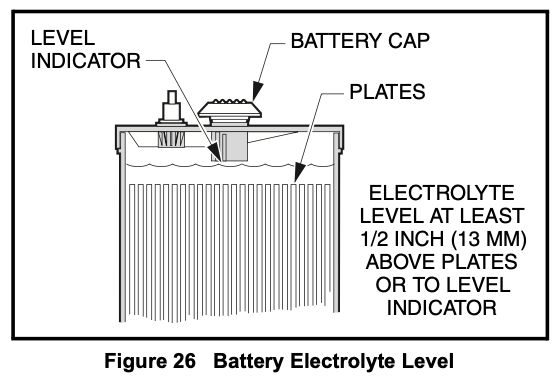
- Theelectrolytelevelinthebatteriesshouldbecheckedweekly(Figure26).Addwateronlyaftercharg- ing unless the electrolyte level is below the top of the plates. In this case, add just enough water to cover the plates, charge and then check the level again. Never charge batteries if plates are exposed above electrolyte level. For best battery life, add only distilled water. See following NOTE.
- NOTE: A battery watering gun or bottle is available at many auto parts dealers.
- Thebatteryhold-downsshouldbetightenoughsothatthebatteriesdonotmovewhilethevehicleisin motion, but not so tight as to crack or buckle the battery case. Tighten hold-down retaining nuts to 40 in- lb (4.5 N·m). The terminal connections should be clean and tight, and any worn insulation or frayed wires should be replaced. Tighten battery terminals to 110 in-lb (12.4 N·m). See following WARNING.
WARNING
- If battery wire terminals are damaged or corroded, they should be replaced or cleaned as necessary. Failure to do so may cause them to overheat during operation and could result in fire, property damage, or personal injury.
- Afteruse,thebatteriesshouldbeplacedoncharge.Thebatteriesshouldneverbeleftdischargedany longer than absolutely necessary (do not leave discharged overnight).