Help Centre
The charger uses DC battery voltage through the onboard computer to close the charger relay which acti-vates the charger AC circuit. When the charger is operating properly, there is a 2 to 15 second delay after the DC cord is plugged into the vehicle before the relay closes. This delay allows time for the DC plug to make a secure connection with the receptacle before the AC circuit is activated and AC power is supplied to the pri-mary coil of the transformer. When the relay closes an audible “click” can be heard, and then as power is sup-plied, the transformer should hum and the ammeter should indicate the charge rate.
Test Procedure 1 - Battery Voltage Too Low or Faulty Connection Between Plug and Receptacle
1. Check the DC plug and receptacle for damage, dirt, corrosion, or any condition that might prevent a good electrical connection.
2. Inspect the receptacle contacts to ensure that they are not damaged and they are firmly seated within the receptacle.
3. Check the wire connections to the charger receptacle:
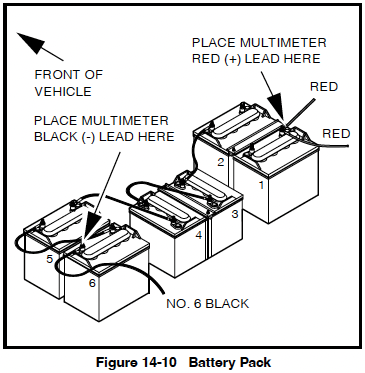
4. With multimeter set to 200 volts DC, measure the voltage of the battery pack between the positive post of battery No. 1 and the negative post of battery No. 6 (Figure 14-10). Normal no-load voltage will be 50 to 52 volts for fully charged batteries. The voltage of the battery pack must be over 32 volts DC in order to allow the onboard computer to close the charger relay. If battery pack voltage is too low to start charger, see below for, Charging Battery Pack With Low Voltage.
CHARGING BATTERY PACK WITH LOW VOLTAGE
1. Turn the key switch OFF and place the Forward/Reverse rocker switch in NEUTRAL. Leave the batter-ies connected and leave the 23-Pin connector plug connected to the controller.
2. If battery pack voltage is below 34 volts, the charger will not activate. The charger relay will have to be by-passed in order for the charger to activate.
3. Disconnect the DC cord from the charger receptacle and unplug the AC cord from the electrical outlet.
4. Remove the eight screws securing the charger cover and remove the cover from the charger.
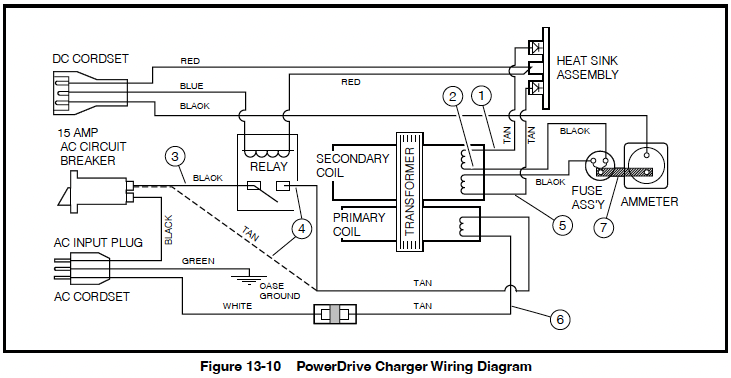
5. Inside the charger, locate the black wire (3) that goes from the circuit breaker to the relay and discon-nect it from the circuit breaker terminal. Make sure this wire does not touch the charger housing or any other charger components (Figure 13-10).
6. Disconnect the transformer wire (4) from the relay and then connect this wire to the open terminal on the circuit breaker (Figure 13-10).
7. Plug the DC cord into the charger receptacle first, and then plug the AC cord into an electrical outlet.
8. The charger should activate and begin to charge the batteries. Allow the charger to operate for one or two hours. See following WARNING.
9. After one or two hours, disconnect the charger AC cord from the electrical outlet first. Then disconnect the DC cord from the charger receptacle in the vehicle.
10. Disconnect the transformer wire from the circuit breaker and connect it to the relay. Reconnect the short black wire from the relay to the circuit breaker.
11. Install the charger cover and the eight retaining screws.
12. Plug the DC cord into the charger receptacle and plug the AC cord into an electrical outlet.
13. Allow the charger to continue charging the batteries until the charger shuts off automatically.
14. When the charge cycle is complete, test the batteries again. If the battery pack voltage is above 34 volts and the vehicle will not operate, it will be necessary to troubleshoot the vehicle’s electrical system to determine which electrical component has failed.